Research Topics
|
We are working with a dataset that was collected by the Center on Literacy and Deafness at Georgia State University (https://sites.gsu.edu/clad/). Researchers video recorded literacy interactions in early elementary classrooms (kindergarten, first grade, and second grade) that have Deaf or hard-of-hearing students. Some classes were being taught in American Sign Language (ASL) and some were taught in spoken English. We have transcribed and annotated video clips from these classrooms and are interested in the following research questions:
· What visually-grounded attention strategies (like pointing, gesturing, waving) do teachers in ASL versus spoken English classrooms use when they are reading books aloud or doing literacy activities in the classroom?
· What does turn-taking look like during book-sharing or literacy activities in these classrooms? Is it similar or different for ASL versus spoken English classrooms? Do students get equal opportunities to participate? Are there strategies particular to one of the languages for supporting students’ participation?
You can see a video of one presentation about this project here [link], from the 2022 American Educational Research Association Meeting (AERA) in San Diego, CA
Horton, Laura, Amy Lederberg, and Jenny Singleton. “Visual Attention Management During Book Reading Activities with Deaf and Hard of Hearing Students.”
A written abstract of this presentation is available here.
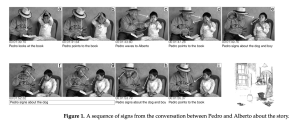 Signed languages have a unique capacity for representation or depiction of people and events being described. Signers can use their own body to show or “depict” how someone was looking, or what their facial expression was, or to show someone’s reaction. This has been labeled “constructed action” (among other terms) and we are interested to see how it is used in signing that is intended for children. We are looking at the frequency, type, and structure of constructed action in signed story books for kids. We will compare constructed action in these stories with other examples of signing, including news stories and interviews, that are intended for an adult audience, to see if signers use constructed action at similar rates, and/or if they set up constructed action differently. Eventually, we plan to look at how child signers start to incorporate constructed action in their own narratives and storytelling.
 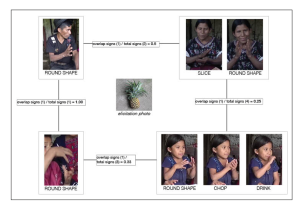 Just as people can use different spoken words for the same thing – like “soda” versus “pop” [link]– signers have a variety of signs available to them that can be used to refer to the same concept. Sometimes these different signs are associated with factors like age, gender, region or signing background. We study and document variation in small local sign languages used in Nebaj, Guatemala and, in an upcoming project, in American Sign Language (ASL) in the United States. In the local sign languages we study in Guatemala, we are interested in how much signers vary from each other when they are signing together frequently or rarely. Signers in Nebaj sometimes have deaf relatives or friends that they see at school daily, other signers do not often sign with deaf people but still interact with hearing people. In some of our work, we have found that signers who interact more often are more likely to use the same signs. You can read more about this work in this paper Glossa and see how we presented this in these posters at conferences NWAV and TISLR.
One new question for us is how consistent signers are over time. We know that all language users change the words they use as they move to new places, interact with new people, learn other languages, and have different experiences. We have longitudinal data that we collected from signers in Guatemala – they did the same task across 5 years – so we can see how much they change or stay the same. We are hoping to collect similar data from ASL signers to see if they are consistent or change the signs they use over time.
Just as people can use different spoken words for the same thing – like “soda” versus “pop” [link]– signers have a variety of signs available to them that can be used to refer to the same concept. Sometimes these different signs are associated with factors like age, gender, region or signing background. We study and document variation in small local sign languages used in Nebaj, Guatemala and, in an upcoming project, in American Sign Language (ASL) in the United States. In the local sign languages we study in Guatemala, we are interested in how much signers vary from each other when they are signing together frequently or rarely. Signers in Nebaj sometimes have deaf relatives or friends that they see at school daily, other signers do not often sign with deaf people but still interact with hearing people. In some of our work, we have found that signers who interact more often are more likely to use the same signs. You can read more about this work in this paper Glossa and see how we presented this in these posters at conferences NWAV and TISLR.
One new question for us is how consistent signers are over time. We know that all language users change the words they use as they move to new places, interact with new people, learn other languages, and have different experiences. We have longitudinal data that we collected from signers in Guatemala – they did the same task across 5 years – so we can see how much they change or stay the same. We are hoping to collect similar data from ASL signers to see if they are consistent or change the signs they use over time.
Pragmatics is the term in linguistics for skills like turn-taking, maintaining the conversational topic, initiating new topics, responding appropriately to questions, and resolving communication breakdowns. We are interested in how deaf and hard-of-hearing children develop these abilities in different linguistic and educational settings. Studies suggest that some pragmatic skills, like conversational repair strategies – responding to miscommunications or misunderstandings in a conversation – may be a particular challenge for DHH students, even when other language skills are age-appropriate (Most, 2002). Limitations with pragmatic skills have direct implications for DHH students peer relations and social life. In a mixed-methods study of DHH adolescents, researchers found that lower pragmatic skills were associated with higher perceived stress. We have written about strategies that local signers from Guatemala use when signing with new communication partners Horton_2020_SLS and how they engage in “repairs” when communication breaks down Horton_2024_SLS_ConvRepair. We will next consider the development of these skills for children using ASL.